Choosing the right bathroom door can influence privacy, ventilation, maintenance, and the visual quality of an entire project. For global buyers, the decision is rarely based on appearance alone. Humid climates, narrow openings, frequent cleaning, and different installation conditions all affect performance. This guide examines the top 10 Aluminum Bathroom Door types and explains where each design may fit best.
An Aluminum Bathroom Door offers useful advantages in wet areas. Aluminum resists common moisture-related problems, while powder-coated or anodized finishes can support long-term surface protection. However, quality depends on more than the frame. Buyers should examine alloy strength, profile thickness, corner connections, hinge capacity, drainage details, glass or panel compatibility, and seal performance. Small details matter. A weak hinge can cause sagging. Poor drainage can leave water near the threshold. Thin seals may harden sooner in demanding environments.
The ten door types in this overview include hinged, sliding, folding, pivot, framed glass, frameless-look, louvered, composite-panel, pocket, and custom configurations. Each option has practical strengths and limitations. Sliding doors save clearance, but their tracks need regular cleaning. Louvered designs improve airflow, yet they provide less visual privacy. Frameless-look styles appear refined, though installation accuracy becomes more critical. No door is perfect. Even reliable products may perform poorly when measurements, hardware, or local conditions are overlooked. By comparing materials, operating space, finish choices, safety features, and maintenance needs, buyers can make a more informed decision and select a solution suited to their market, project budget, and daily use.
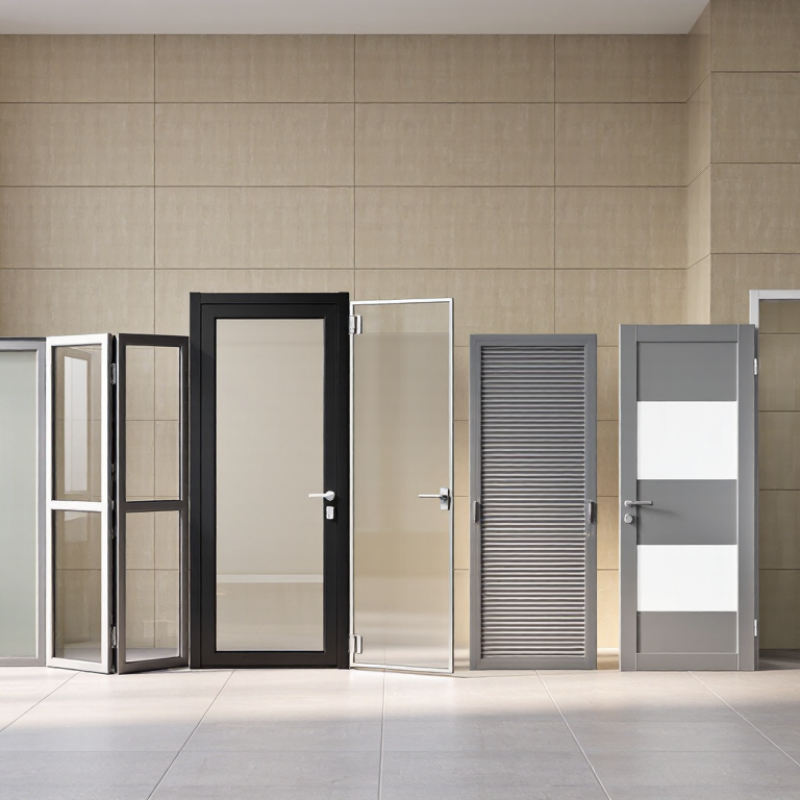
Classify the Top 10 Aluminum Bathroom Door Types by Opening and Layout
Top 10 Aluminum Bathroom Door Types for Global Buyers
Aluminum bathroom doors differ mainly by opening movement and room layout. The top ten options include single-swing hinged doors, double-action swing doors, pivot doors, single sliding doors, bypass sliding doors, barn-style sliding doors, bi-fold doors, tri-fold doors, pocket doors, and corner sliding doors. Hinged models suit wider bathrooms with clear floor space. Pivot doors create a balanced movement and work well in larger entrances. Sliding types save space beside toilets, basins, or narrow shower zones.
Layout matters as much as appearance. A single sliding door fits a straight wall opening. Bypass doors serve wider shower enclosures and allow two panels to overlap. Corner sliding doors suit compact square layouts, while bi-fold and tri-fold systems help protect narrow passageways. Pocket doors disappear into a wall cavity, but installation requires careful planning and compatible wall construction. Double-action doors can improve movement, though they may feel less private without a controlled closing system. Small details matter.
Tips: Measure the finished opening, not only the rough frame. Check swing clearance near fixtures. Choose corrosion-resistant aluminum and suitable seals for humid rooms. Confirm panel weight, track drainage, and handle reach before ordering. Local building requirements may affect glass, ventilation, and door direction. I have found that attractive layouts sometimes fail when cleaning access is ignored. Leave practical space for maintenance.
Compare Framed, Frameless, Sliding, Folding, Pivot, and Bi-Fold Designs
Top 10 Aluminum Bathroom Door Types for Global Buyers
Aluminum bathroom doors balance low weight, moisture resistance, and flexible design. Framed hinged doors remain practical for family bathrooms. Their perimeter frame supports the panel and hides small installation gaps. Frameless hinged doors look lighter and more modern. They demand accurate wall measurements, though. A few millimeters can affect closing performance.
Sliding doors save floor space beside showers or narrow bathroom entrances. Bypass sliding doors work well when two panels move across one another. Folding doors need less swing clearance, while bi-fold doors create a wider opening with compact movement. Pivot doors turn from a central or offset point and suit larger layouts. They feel substantial. However, their swing area needs careful planning.
The remaining options include single-panel framed doors, double framed doors, three-panel folding doors, inward pivot doors, outward pivot doors, and aluminum doors with frosted inserts. Each design changes airflow, privacy, cleaning effort, and accessibility. In humid coastal areas, powder-coated aluminum and corrosion-resistant hardware deserve close attention. Check drainage paths around the threshold. Water trapped near fittings can still cause problems.
For global buyers, door thickness, panel weight, opening direction, and replacement hardware matter as much as appearance. Sliding systems may require cleaner tracks than expected. Folding systems can collect dust at their hinges. Frameless designs expose poor workmanship quickly. A local installer should verify wall conditions before production. Product drawings are useful, but real walls are rarely perfect.
Top 10 Aluminum Bathroom Door Types for Global Buyers
Comparison of common framed, frameless, sliding, folding, pivot, and bi-fold bathroom door designs by typical nominal doorway width.
The chart uses the midpoint of typical residential nominal width ranges. Actual dimensions depend on local building standards, wall conditions, accessibility requirements, hardware, and manufacturer specifications.
Evaluate Aluminum’s 2.70 g/cm³ Density and Corrosion-Resistant Performance
Top 10 Aluminum Bathroom Door Types for Global Buyers: Evaluating 2.70 g/cm³ Density and Corrosion Resistance
Aluminum remains practical for bathroom doors because its density is about 2.70 g/cm³, according to The Aluminum Association’s Aluminum Standards and Data. It weighs roughly one-third as much as steel, easing installation and reducing hinge stress.
Common options include:
- sliding
- folding
- pivot
- framed glass
- frameless glass
- louvered
- bi-fold
- pocket
- barn-style
- ventilated doors
The material also develops a thin, self-protecting oxide film when exposed to air. European Aluminium’s building-sector guidance identifies this oxide layer as a key reason for aluminum’s durability in humid environments. Still, “corrosion-resistant” does not mean corrosion-proof.
Tips:
Check the lower rail after simulated shower exposure. Water, soap residue, and trapped chloride can attack untreated edges. Select drainage holes, sealed joints, and compatible stainless-steel hardware. Avoid direct contact between aluminum and dissimilar metals without suitable isolation. Powder coating can improve appearance and surface protection, but damaged areas still need inspection. Coastal buyers should request salt-spray test evidence, such as ASTM B117 results, while remembering that laboratory hours cannot perfectly reproduce every bathroom.
A lighter door is not automatically a better door. Frame stiffness, glass weight, hinge capacity, and wall fixing remain important. In practice, poorly ventilated bathrooms often expose weaknesses faster than product brochures suggest. That is where specifications need a second look.
Consult local building requirements before final selection.
Apply EN 12150, ANSI Z97.1, and Global Safety-Glazing Requirements
Top 10 Aluminum Bathroom Door Types for Global Buyers?
Bathroom doors often combine aluminum frames with clear, frosted, patterned, or laminated glass. Common options include hinged, sliding, pivot, bi-fold, folding, framed, semi-frameless, frameless, pocket, and barn-style doors. Each design needs careful attention to moisture, hardware strength, glass thickness, and installation space.
EN 12150 applies to thermally toughened soda-lime safety glass. It covers fragmentation, heat-soak considerations, and production quality. ANSI Z97.1 provides another important safety-glazing benchmark, especially for buyers serving North American projects. These standards do not automatically approve the complete door system. The frame, hinges, rollers, seals, and fixing points still require separate evaluation.
Check permanent safety markings, test reports, and the declared glass specification. Ask whether the documentation matches the actual production batch. That detail matters. Some suppliers mention a standard, but provide no traceable evidence. Global requirements can also differ by building code, impact risk, door location, and local inspection rules. Laminated safety glass may be preferred where post-breakage retention is important, although it is not a universal substitute for every specification.
In practical inspections, sharp aluminum edges, weak corner joints, and poor drainage often create more trouble than the glass itself. A door may pass a glass test and still perform poorly after installation. Recheck tolerances, seal compression, and hardware compatibility. Perfect coordination is uncommon. Clear records reduce avoidable mistakes.
Use IAI’s 75% Reuse Estimate to Assess Sustainability and Lifecycle Value
Top 10 Aluminum Bathroom Door Types for Global Buyers?
Aluminum bathroom doors can offer practical lifecycle value when buyers examine more than the purchase price. The International Aluminium Institute estimates that about 75% of aluminum ever produced remains in use. This figure supports aluminum’s long-term recovery potential, but it is not a guarantee. Door design still matters.
For global buyers, hinged, sliding, folding, louvered, framed glass, frameless glass, pocket, bifold, pivot, and fire-rated aluminum doors can serve different bathroom layouts. Choose corrosion-resistant alloys for humid or coastal environments. Check the coating thickness, hinge material, seal quality, and drainage details. Small components often fail first.
Reuse depends on clean separation and local processing capacity. Avoid unnecessary bonded composites when possible. Mechanical fasteners can simplify repair and disassembly. Keep alloy records and request credible recycled-content documentation from suppliers. A door with replaceable rollers may remain useful longer than a cheaper sealed unit. That difference is easy to overlook.
The 75% estimate should guide lifecycle thinking, not replace product testing. Mixed metals, damaged frames, paint layers, and contaminated hardware can reduce recovery value. In my experience, maintenance access often matters more than impressive sustainability claims. Measure twice. Details matter. A realistic assessment includes transport distance, replacement frequency, installation quality, and the actual recycling route available in the destination market.
FAQS
Sliding, bi-fold, or tri-fold doors usually save floor space. They avoid hitting toilets, basins, or shower fittings. Measure twice.
Hinged doors work well when the bathroom has clear floor space. Check the swing path beside fixtures before ordering. A beautiful door can still block movement.
Corner sliding doors suit compact, square shower areas. They use two meeting panels and preserve the central walkway. Cleaning access needs attention.
It can disappear inside a wall cavity and leave the bathroom open. The wall must support the cavity and internal track. Existing walls may need major changes.
Aluminum weighs about 2.70 grams per cubic centimeter. Its light weight reduces hinge stress and simplifies installation. It is corrosion-resistant, not corrosion-proof.
Choose drainage holes, sealed joints, and compatible hardware. Inspect the lower rail after water and soap exposure. Coastal rooms deserve extra caution.
Request safety-glazing records and permanent markings. Check the actual glass thickness and production documentation. The complete door still needs separate inspection.
No. Frame stiffness, glass weight, hinge capacity, and wall fixing still matter. A lighter frame can perform poorly. Specifications deserve a second look.
Measure the finished opening, not only the rough frame. Check handle reach, panel weight, swing clearance, and track drainage. Small errors become expensive later.
Leave space for cleaning, seal inspection, and hardware adjustment. Look for trapped water near rails and corners. I have overlooked this before. It matters.
Conclusion
Choosing the right Aluminum Bathroom Door starts with understanding how opening style and bathroom layout affect usability, space, and installation. The top ten types include framed and frameless hinged doors, sliding doors, folding and bi-fold doors, pivot doors, corner enclosures, and compact configurations for narrow or irregular spaces. Each design offers different advantages in accessibility, ventilation, cleaning, visual openness, and space efficiency, allowing global buyers to match the door with residential, hospitality, or commercial applications.
Aluminum is a practical material because its density is approximately 2.70 g/cm³, making it lightweight while providing good corrosion resistance in humid environments. Buyers should also confirm that the glass and hardware meet applicable safety-glazing requirements, including EN 12150, ANSI Z97.1, and relevant local standards. From a sustainability perspective, aluminum’s potential for repeated recovery and reuse—estimated at around 75% in suitable applications—can improve lifecycle value, reduce material waste, and support more responsible long-term purchasing decisions.