
Window Wurx Industry Co., Ltd. — China's Trusted Aluminum Windows & Doors Manufacturer Since 1993
Choosing among China’s top 10 Aluminium Sliding Doors manufacturers requires more than comparing attractive product photographs. A reliable shortlist should examine factory experience, material quality, testing records, and after-sales support. Aluminium profiles should have consistent wall thickness, clean powder coating, and accurate corner joints. Rollers must move smoothly, even when the panel is large and heavy. Small details matter.
Architect Ludwig Mies van der Rohe famously said, “God is in the details.” His words remain relevant here. A sliding door may look impressive in a showroom, yet poor drainage, weak hardware, or inaccurate installation can create problems later. This guide therefore considers manufacturers through a practical building-envelope perspective. It looks at thermal performance, glazing options, wind resistance, customization, production capacity, and export experience. Certifications are useful, but they should be checked against current documents, not accepted as decoration.
No ranking can fit every project perfectly. A coastal villa needs different protection from an interior office renovation. Budget, climate, opening size, and local installation skills also change the decision. Some manufacturers communicate clearly, while others leave important technical answers uncertain. That uncertainty deserves attention. The companies discussed in this guide are assessed using available evidence, including product information, manufacturing capability, market reputation, and customer feedback. Site visits and independent verification remain valuable. A polished catalogue is not proof. Real performance is measured after years of opening, closing, rain, dust, and daily use.
What Are Aluminium Sliding Doors?
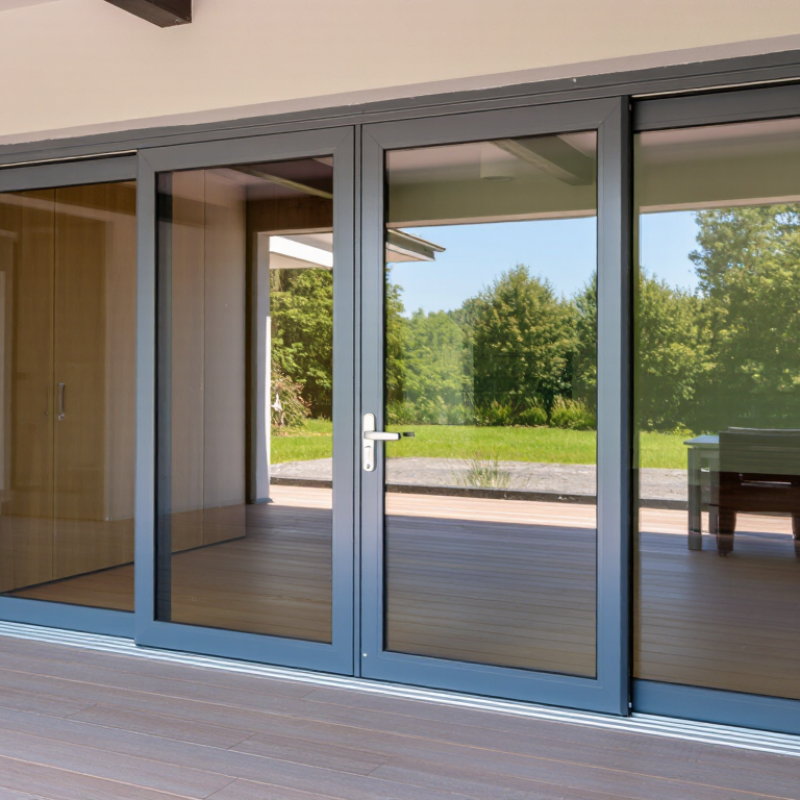
Aluminium sliding doors are large glazed door systems that move horizontally along tracks. Their frames use lightweight, corrosion-resistant aluminium profiles. Rollers carry the panels, while seals reduce drafts, dust, and rain entry. Many systems include thermal breaks, which separate indoor and outdoor aluminium surfaces. This design limits heat transfer through the frame.
Glass selection matters as much as the frame. The U.S. Department of Energy estimates that windows can cause 25–30% of residential heating and cooling energy use. Large sliding panels may increase this exposure. Low-emissivity glass, insulated glazing, and careful installation can improve comfort. However, performance depends on the complete system, not one impressive specification. A perfect seal is rarely guaranteed.
Tips: Check the door’s U-value, solar heat gain coefficient, air leakage rating, and water resistance. Ask for tested performance data, not vague phrases like “energy saving.” Inspect the track depth and drainage openings. The International Aluminium Institute reports that aluminium recycling uses about 95% less energy than primary production, making recyclable frames a practical sustainability choice. Still, recycling claims require responsible collection and processing. Misalignment can also appear after years of heavy use, especially on wide panels. Choose properly sized rollers and schedule track cleaning.
Aluminium sliding doors typically combine lightweight aluminium frames with glass panels. The chart compares approximate room-temperature densities of common materials used in or around sliding-door systems. Lower density generally means lower material weight for the same volume.
Reference values: aluminium alloys ≈ 2.70 g/cm³, architectural glass ≈ 2.50 g/cm³, rigid PVC ≈ 1.40 g/cm³, and carbon steel ≈ 7.85 g/cm³. Actual values vary by alloy, glass composition, and product specification.
Selecting China’s top ten aluminium sliding door manufacturers requires more than counting website visits or product photos. The evaluation begins with proven production experience, including factory history, annual capacity, and completed projects. Auditors should review aluminium grades, coating thickness, hardware quality, glass specifications, and assembly accuracy. Sample doors must slide smoothly, close evenly, and resist visible frame movement.
Technical credibility also matters. Reliable manufacturers provide traceable test reports, quality procedures, installation guidance, and clear warranty terms. Export experience can show operational reliability, but it should not replace direct verification. Customer references, inspection records, response times, and documented after-sales practices create stronger evidence. Independent audits and factory visits add authority. Still, no scoring model is perfect. A polished showroom can hide inconsistent batch control.
Tips: Request a production sample before signing a large order. Measure frame tolerances with simple tools. Check corner joints, drainage paths, rollers, locks, and protective packaging. Ask how defects are recorded and corrected. Compare at least three quotations using identical specifications. Very low pricing deserves careful questioning. The final ten should reflect balanced performance, not advertising strength. Selection should remain transparent, repeatable, and based on evidence gathered from both documents and real products.
China’s Top 10 Aluminium Sliding Door Manufacturers are often judged by more than factory size.
Reliable producers combine certified aluminium profiles, accurate cutting, and stable hardware supply. Their doors should slide quietly, even after thousands of cycles.
Strong manufacturers also provide clear drawings, finish samples, and production photographs.
Look closely at frame thickness, thermal-break design, roller capacity, and drainage details. A well-made door should resist water during heavy rain and remain square after installation.
Powder coating quality matters too, especially in coastal areas where salt air can damage weak finishes. The strongest suppliers usually offer testing records, inspection support, and practical installation guidance.
Still, “top ten” lists can be imperfect. Some factories excel at custom projects but lack consistent export documentation. Others have impressive showrooms but limited after-sales support.
Tips:
Request a physical corner sample before ordering. Test the rollers by hand. Ask for profile specifications, glass options, warranty terms, and packing photos. Confirm whether replacement rollers are available locally. Compare several quotations, but do not choose by price alone. A cheaper frame may bring alignment problems later. Check factory experience with your climate, opening size, and building standards. Video inspections can help, though they cannot replace independent quality checks. Experience suggests that detailed communication prevents more problems than attractive brochures.
Comparing the top ten manufacturers requires more than checking catalogue photos. Product differences appear in frame depth, thermal breaks, glass options, drainage, rollers, and locking systems. A strong sliding door should move smoothly, even with a large insulated glass panel. Inspect the bottom track carefully. Poor drainage can leave water near the interior sill after heavy rain.
The U.S. Department of Energy reports that windows can cause 25–30% of residential heating and cooling energy use. Therefore, low-e glass, proper seals, and thermally broken frames deserve serious attention.
Quality also depends on testing and production discipline. Ask for air infiltration, water penetration, structural performance, and thermal data.
The International Aluminium Institute states that recycled aluminium requires about 5% of the energy used for primary aluminium production. This supports sustainability, but recycled content alone does not prove better performance.
Customization is another dividing line. Some factories adjust frame colors only. Better suppliers can modify panel sizes, handle positions, glass thickness, screen systems, and sill details.
Site measurements still matter. Even a good factory drawing may fail when walls are uneven.
Tips:
Request a physical corner sample, not only digital images. Check roller adjustment with one hand. Ask for test reports and warranty terms in writing. I would not trust the phrase “premium quality” without measurable specifications. A polished showroom sample can hide weak installation details. Compare tolerances, hardware replacement access, and packaging protection before choosing.
China Top 10 Aluminium Sliding Door Manufacturers: How to Choose the Right Chinese Manufacturer
Choosing from China’s top aluminium sliding door manufacturers requires more than comparing online photos. Check their factory experience, production equipment, and export history. A reliable supplier should explain aluminium grades, profile thickness, glass options, hardware sources, and surface treatments clearly. Ask for recent factory videos or arrange a live inspection. A polished showroom can hide weak quality control.
Request a complete sample before placing a large order. Test the rollers, locks, seals, frame joints, and drainage holes by hand. Measure opening sizes carefully. Ask for inspection records, packaging details, and replacement procedures. Verify whether the quoted price includes glass, hardware, protective film, and delivery terms. Small omissions can become expensive later. I have found that clear drawings prevent more disputes than friendly promises. Still, drawings may contain mistakes, so review every dimension twice.
Tips: Compare at least three manufacturers. Ask for the same specifications from each supplier. Check response speed and technical accuracy, not only price. Choose a manufacturer that explains risks honestly, even when the answer is inconvenient. Confirm sample approval, production timelines, and pre-shipment inspection in writing. If a supplier avoids direct questions, pause the decision. A lower quote is not always a saving. Test the door repeatedly. Also, leave room for improvement; your first specification may not suit the building’s climate or daily use.
| Rank | Anonymous Manufacturer Profile | Typical Product Focus | Common System Options | Typical Performance Range | Surface Finish Options | Customization Capability | Indicative Lead Time | Warranty Range | Documents to Request | Best Fit |
|---|---|---|---|---|---|---|---|---|---|---|
| 1 | Profile A — Premium Export Specialist | Large-format residential and villa sliding doors | Thermal-break, lift-and-slide, multi-track | Large panels up to approximately 6–8 m² per sash, subject to glass and hardware selection | Powder coating, anodizing, wood-effect finishes | High; custom dimensions, colors, glass, hardware, and drainage details | 35–55 days after approved drawings and deposit | 5–10 years for frame finish; hardware terms vary | Test reports, coating certificate, glass specification, installation drawings | High-end residential and hospitality projects |
| 2 | Profile B — Engineering-Focused Fabricator | Energy-efficient doors for residential developments | Thermal-break, double-glazed, concealed drainage | Designed for improved air, water, and wind resistance; project testing required | Standard and premium powder coating; anodized aluminum | High; engineering review and shop-drawing support available | 30–50 days for standard project configurations | 5 years commonly offered; confirm exclusions | Section drawings, material certificates, test reports, packing list | New-build apartments and energy-conscious homes |
| 3 | Profile C — High-Volume Project Supplier | Standardized doors for multi-unit construction | Two- or three-track, standard sliding, fixed-plus-sliding combinations | Consistent production dimensions with project-specific wind-load review | Common architectural colors and anodized finishes | Medium to high; strongest for repeatable designs | 25–45 days depending on quantity and glass availability | 2–5 years, depending on product category | Quality plan, batch inspection records, container loading photos | Developers, contractors, and repeat purchasing programs |
| 4 | Profile D — Custom Architectural Workshop | Bespoke doors for luxury homes and architectural projects | Slim-frame, panoramic, pocket, corner-opening systems | Project-specific sizing and hardware calculations required | Custom powder coating, anodizing, and wood-effect finishes | Very high; suitable for non-standard geometry and details | 45–70 days, including design confirmation | 5–10 years for selected components | Approved drawings, finish samples, hardware data, installation manual | Architect-led and design-sensitive projects |
| 5 | Profile E — Mid-Market OEM Partner | Private-label residential door programs | Standard sliding, thermal-break, insect-screen combinations | Suitable for common residential sizes; verify local code compliance | Powder coating and anodized finishes in standard colors | Medium; packaging and labeling customization usually available | 25–40 days after production approval | 2–5 years, subject to contract terms | Pre-production sample, inspection report, carton and pallet details | Importers, distributors, and regional dealers |
| 6 | Profile F — Coastal-Climate Specialist | Doors for humid, coastal, and high-exposure environments | Thermal-break and reinforced multi-point locking systems | Corrosion-resistance strategy depends on alloy, coating, hardware, and maintenance | Marine-grade pretreatment options, powder coating, anodizing | High; hardware and finish can be specified for exposure conditions | 35–60 days depending on treatment and hardware | 5 years commonly available; maintenance conditions apply | Pretreatment details, coating specification, salt-spray data where applicable | Coastal housing, resorts, and humid climates |
| 7 | Profile G — Energy-Efficiency Specialist | High-performance doors for colder or hotter climates | Thermal-break, insulated glass, warm-edge spacer options | Thermal values vary by frame, glass, spacer, size, and test method | Powder coating, anodizing, and dual-color interior/exterior options | High; glazing and thermal specifications can be project-based | 35–60 days after technical approval | 5–10 years depending on frame and hardware package | Thermal test data, U-value calculation, glass certificate, drawings | Passive-house-oriented and climate-controlled buildings |
| 8 | Profile H — Commercial Renovation Supplier | Replacement and renovation sliding door systems | Retrofit frames, narrow-depth systems, standard sliding doors | Designed around site dimensions; survey accuracy is critical | Standard powder coating and anodized finishes | Medium to high; stronger for replacement-size projects | 25–45 days for repeatable profiles | 2–5 years; installation workmanship should be defined separately | Site measurement sheet, installation details, spare-parts list | Renovation contractors and replacement-window distributors |
| 9 | Profile I — Value-Oriented Factory Supplier | Cost-sensitive residential and light-commercial projects | Standard sliding, single-glazed or double-glazed configurations | Best suited to moderate sizes and normal exposure conditions | Standard powder coating and anodizing | Medium; limited changes preferred for cost control | 20–40 days depending on order size | 2–5 years depending on configuration | Material grade, hardware list, pre-shipment inspection report | Budget-controlled projects with clear specifications |
| 10 | Profile J — Small-Batch Custom Manufacturer | Custom residential orders and trial-market products | Standard sliding, thermal-break, special-color options | Performance depends strongly on the selected profile and hardware package | Powder coating and anodizing; color availability should be confirmed | High for small quantities, but profile selection may be narrower | 30–55 days, including sample approval | 2–5 years, subject to written warranty terms | Sample approval sheet, dimensional inspection, packaging photos, warranty terms | Small importers, prototypes, and limited-volume projects |
They are large glazed doors that move horizontally along tracks. Rollers support the panels. Seals help block drafts, dust, and rain.
Thermal breaks separate indoor and outdoor aluminium surfaces. They reduce heat transfer through the frame. They do not guarantee perfect insulation.
Low-emissivity glass and insulated glazing can reduce heat transfer. Large glass panels may still increase solar exposure. Installation quality matters greatly.
Ask for the U-value, solar heat gain coefficient, air leakage rating, and water resistance. Request tested data, not vague energy claims.
Review aluminium grades, coating thickness, hardware, glass specifications, and assembly accuracy. Visit the factory or request a live inspection. Photos can mislead.
Slide the panels repeatedly. Check rollers, locks, seals, corner joints, drainage holes, and frame movement. A smooth first test is not enough.
Request identical specifications from at least three suppliers. Confirm glass, hardware, packaging, delivery terms, and warranty coverage. Small omissions become expensive.
Aluminium frames can be recycled, using far less energy than primary production. Recycling still depends on proper collection and processing. The claim needs verification.
Choose properly sized rollers and clean the tracks regularly. Wide panels may become misaligned after years of heavy use. I might underestimate local climate effects.
Unclear answers, missing test records, and unusually low prices deserve caution. Review every drawing twice. Friendly promises are not technical evidence.
This article provides a practical overview of Aluminium Sliding Doors and explains why they are widely used in residential, commercial, and architectural projects. It introduces their main features, including smooth operation, space-saving design, natural lighting, ventilation, durability, and compatibility with different glass and frame configurations. The article also explains how China’s top 10 manufacturers are selected by considering product quality, manufacturing capabilities, technical expertise, customization options, certifications, production capacity, service, and customer feedback.
Readers will also learn about the key differences among manufacturers in materials, surface finishes, hardware, thermal performance, security, design flexibility, and quality control. The final section offers useful guidance for choosing the right Chinese manufacturer, focusing on project requirements, technical communication, sample evaluation, lead times, pricing, after-sales support, and export experience. This summary helps buyers compare suppliers more effectively and make a suitable decision for their specific construction or renovation needs.